
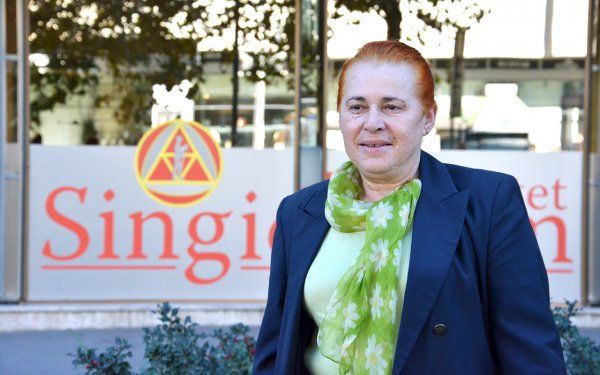
Retired full professor, Singdunum University, Belgrade, Republic of Serbia
Prof. Dr. Zora Konjović is a retired full professor at the University of Novi Sad in the field of applied computer science and informatics. She is currently employed as the director of the Novi Sad Center of Singidunum University, where she was elected full professor in the field of Computer Science and Informatics. She completed basic academic studies in mathematics at the Faculty of Science and Mathematics at the University of Novi Sad. She defended her master's thesis and doctoral dissertation in the field of robotics at the Faculty of Technical Sciences in Novi Sad. Her professional activity includes teaching, scientific research and managerial work. Professor Konjović made a significant contribution to the development of IT education through the establishment of numerous courses and teaching at undergraduate, master's and doctoral studies and, in particular, the introduction of the latest IT achievements into the university curriculum. She was the mentor of 12 doctoral theses, 11 master's theses and over 150 graduate theses. At the Faculty of Technical Sciences of the University of Novi Sad, she was the founder of several educational/research laboratories and centers focused on cooperation with industry. As part of scientific research activities, she has published over 300 scientific papers in the field of informatics and computing, artificial intelligence, robotics, automation and technologically improved learning and education, among which are chapters in international monographs, more than a dozen papers in international journals from the SCI list, numerous papers in domestic scientific journals, international and domestic scientific conferences, and complex software systems to support the research information system. During her career, she successfully performed several management duties at the Faculty of Technical Sciences (head of the department, director of the department, etc.), Provincial Government of the Autonomous Province of Vojvodina (deputy minister for science and technological development), European Commission (representative of the Republic of Serbia in the EU panel for the development of the information society), and Ministry of Science and Technological Development of the Republic of Serbia (member of the Interdisciplinary Scientific Committee for Information Technologies, member of the Scientific Committee for Industrial Software).
Keynote speaker: prof.dr Zora Konjovićlink to session
The digital twin paradigm is extremely „hot“ and widely applied in a large number of areas of development and functioning of modern society. Although the term itself dates back to the beginning of the century, it was especially actualized in the last decade of this century as a function of the Industry 4.0 paradigm, which focuses on the automation of industrial processes, followed by Industry 5.0, which shifts that focus to humans, emphasizing sustainability and promoting cooperation between humans and technology.
In the context of the concept of infrastructure, the digital twin paradigm can be viewed in two dimensions:
- As part of a set of digital artifacts and systems to implement the concept of infrastructure defined as a set of objects and systems that serve a country, city or other area and include services and facilities needed for the functioning of the economy, households and companies.
- As a set of facilities and systems for the development of digital artifacts that serve the functioning of the economy, households and companies in a country, city or other area.
The focus of the lecture is on the second dimension, which means that it primarily deals with objects and systems used to develop digital twins.
The lecture is organized in three connected parts.
The first part defines the concepts of infrastructure and digital twin in context.
The second part identifies the fundamental concepts, components, technologies and characteristic infrastructure systems for the development of digital twins.
The third part presents an example of infrastructure for working with digital twins where the infrastructure is represented by an extensible software platform for digital twins that should enable the sustainable development of digital twins. In addition to models and examples of prototypical implementation of the platform, examples of its use for selected cases are presented.
The last, fourth part brings concluding considerations summarizing the state of the field and identifying challenges in its further development.